
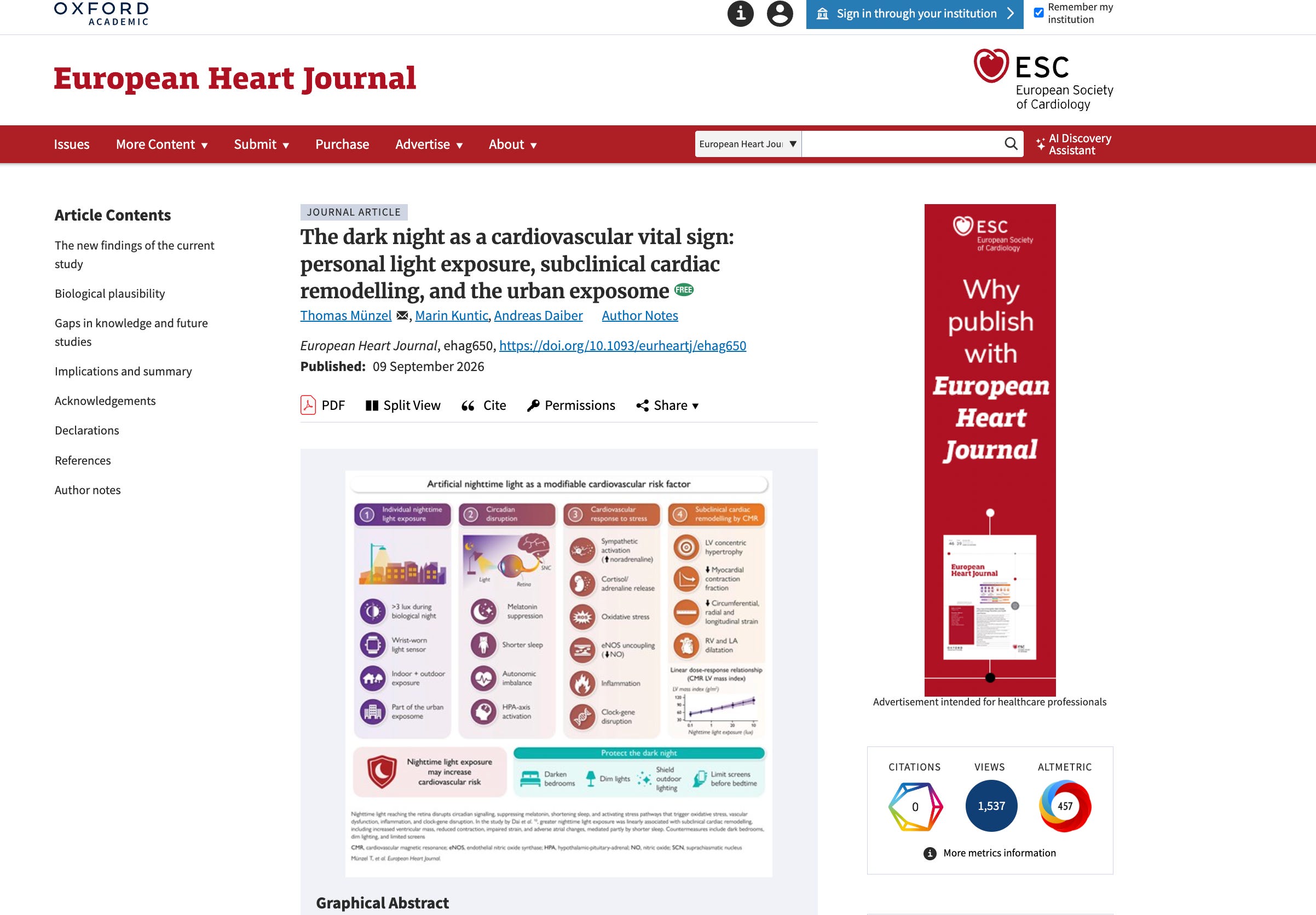
A few days ago, in the European Heart Journal, three respected cardiovascular researchers proposed something that, to a casual reader, sounds ridiculous. They called for a randomised controlled trial of blackout curtains. Alongside the curtains they proposed trialling dim, warm bedroom light after sunset — all as cardiac medicine. The bedroom, in other words, has entered the same conversation as the statin and the stent. In the editorial’s own words,
“The light in our bedrooms deserves consideration as a cardiovascular risk factor, alongside smoking, hypertension, and physical inactivity.”
What prompted a proposal like that was the study the editorial accompanied. Researchers took more than eleven thousand people who had worn a light sensor on the wrist for a week, waited about three years, and then looked at their hearts with an MRI. Those who had slept in the most light had visibly different hearts — thicker-walled, weaker-pumping, the pattern doctors call remodelling and usually see in a heart under chronic strain. And the more the light, the stronger the pattern.
Then they widened the lens. A parallel analysis of more than seventy thousand people tracked cardiovascular diagnoses and deaths for up to a decade after each person’s light at night was measured. Those with the highest exposure had more heart attacks, more strokes, more deaths from heart disease — every one raised by a quarter to a third. As the editorial noted, that is a wider margin than many of the risks heart drugs are built to remove.
But light at night does not stop at the heart. The heart is simply what this study measured. Darkness is a whole-body signal, one life has evolved with since life began, and when we interfere with it, the effects ripple through the body. For years, in study after study, artificial light at night has been tied to the different chronic diseases that plague modern life — breast cancer, prostate cancer, neurodegeneration, obesity, depression, heart disease. Not small trials on a handful of volunteers, but whole populations, across different countries and different methods, and the associations keep coming back.
A nationwide Chinese study, published in 2023, compared five years of death records with satellite maps of night-time brightness. The brighter the nights, the higher the death rate — from nearly every natural cause. A year later, an American study mapped all forty-eight mainland states against Medicare records and found more Alzheimer’s where the nights were brighter. In people under sixty-five, the glow outside the bedroom window predicted Alzheimer’s more powerfully than anything else they measured. Take a breath and sit with that for a moment — think about exactly what it means: light at night was more predictive of Alzheimer’s than their blood sugar, more than their blood pressure, more than their weight.
The thread runs on into cancer too — breast cancer most insistently. A Harvard team followed more than a hundred thousand women for over two decades and found that those living where the nights were brightest had about fourteen per cent higher odds of breast cancer than those in the darkest neighbourhoods. Scientists suspect the reason is melatonin supression, the hormone of biological night, which light entering the eye shuts down. And the sharpest clue comes from women who cannot register that light at all. In a North American study of nearly 1,400 blind women, those with no perception of light had less than half the odds of breast cancer of women who were blind but could still detect light.
I have been following these patterns for years, and badgering my friends and loved ones about them — a silk eye mask has become my go-to Christmas present. I am used to the familiar retort: “So what are you saying, Nikki — my lights cause cancer, depression, diabetes?” They say it politely, but make up your mind is implied. From scientists, the reply is sharper: correlation isn’t causation.
But this misses the point. Yes, each finding alone is only an association; none proves that darkness by itself would have changed an outcome. The power is in the convergence — different diseases, different organs, different continents, the same signal. We each carry our own genetic weak points, and a disruption this fundamental finds them — heart disease in one person, diabetes in another, a mind that won’t settle in a third. One signal, pulling at whatever is weakest. The researchers who called for those trials had weighed this same objection, and were unequivocal:
“The relationship is biologically coherent, the effect sizes are clinically meaningful, and the dose–response is unambiguous: more light, worse outcomes.”
Darkness is not the absence of light. It is the body’s oldest repair signal. And today we have switched it off — a bright light over every room, a screen glowing past midnight, a streetlamp through the curtains, the small standby lights winking from the electronics.
These cardiac researchers are right to call for trials of blackout curtains. That’s how science works: it moves slowly, and regulation slower still. But, to me, if it looks like a duck and quacks like a duck, I have to ask, do we really need a trial to tell us it’s a duck — especially when the intervention carries no risk at all? Most of the light in our own homes is ours to change, and where it isn’t, an eye mask will do. Almost nothing else in health is this simple: virtually no cost, and no behaviour to change.
If you care about your sleep — and you should, it’s the body’s main repair window — you have probably tried the things we all try: melatonin gummies, the magnesium supplement, perhaps even medication. Before the next one, pause and ask what the nervous system is actually waiting for in order to stand down. The most powerful sleep intervention we have is also the oldest, and it is free. Give the body back the dark.
Here is a test you can run tonight. Switch off every light in the bedroom and shut the door. If you can still make out the edge of the curtains, the frame of the window, the shape of the furniture, then light is still reaching you – and here’s the part, that surprised me most, when I first learnt , it can affect you, even when your eyes are closed. So find the source. Cover it, block it, unplug it. Then notice how you sleep.
The cardiac researchers put it as plainly as it can be put:
“Darkness deserves recognition as a vital sign, as essential to cardiovascular health as blood pressure control and clean air.”
Your home is speaking to your body every second of the day and night, whether you are listening or not. So tonight, in the dark, ask the question underneath all of it: what is this room telling my body?
Further Reading
The central cardiac study, and the editorial calling for intervention trials:
Dai J, Dai W, Heianza Y, Qi L. Nighttime light exposure and cardiac structure and function. European Heart Journal. 2026. Read the study
Münzel T, Kuntic M, Daiber A. The dark night as a cardiovascular vital sign: personal light exposure, subclinical cardiac remodelling, and the urban exposome. European Heart Journal. 2026. Read the editorial
On circadian timing and cardiovascular repair:
Shea SA, Scheer FAJL, Gumz ML, et al. Unlocking the potential of circadian biology for cardiovascular health. Physiological Reviews. 2026;106(3):1195–1262. Read the review
Knutson KL, et al. Role of circadian health in cardiometabolic health and disease risk: a scientific statement from the American Heart Association. Circulation. 2025. Read the statement
On light in real homes, and what it does before sleep:
Cain SW, McGlashan EM, Vidafar P, et al. Evening home lighting adversely impacts the circadian system and sleep. Scientific Reports. 2020;10:19110. Read the study
Gooley JJ, Chamberlain K, Smith KA, et al. Exposure to room light before bedtime suppresses melatonin onset and shortens melatonin duration in humans. Journal of Clinical Endocrinology & Metabolism. 2011;96(3):E463–E472. Read the study
On mortality, Alzheimer’s and cancer:
Lu Y, Yin P, Wang J, et al. Light at night and cause-specific mortality risk in Mainland China: a nationwide observational study. BMC Medicine. 2023;21:95. Read the study
Voigt RM, Ouyang B, Keshavarzian A. Outdoor nighttime light exposure (light pollution) is associated with Alzheimer’s disease. Frontiers in Neuroscience. 2024;18:1378498. Read the study
James P, Bertrand KA, Hart JE, Schernhammer ES, Tamimi RM, Laden F. Outdoor light at night and breast cancer risk in the Nurses’ Health Study II. Environmental Health Perspectives. 2017;125(8):087010. Read the study
Flynn-Evans EE, Stevens RG, Tabandeh H, Schernhammer ES, Lockley SW. Total visual blindness is protective against breast cancer. Cancer Causes & Control. 2009;20(9):1753–1756. Read the study