The Framework
Nervous System Design (NSD) begins with a simple observation: the home is not neutral.
The environments we live in are constantly sending signals to the nervous system. Light, sound, air, climate, scent, touch, chemistry, space, and movement shape how the body regulates itself . These signals are processed continuously, whether we are aware of them or not.
Most health conversations focus on behaviour: what we eat, how we move, how well we sleep. NSD shifts the lens. It asks how the built environment itself modulates the regulatory systems that make those behaviours effective. When environmental signals are aligned with the nervous system’s expectations, regulation strengthens. When they are flattened, mistimed, or distorted, the body must work harder to maintain balance.
This framework draws on research from evolutionary biology, circadian science, autonomic neuroscience, environmental health, and stress physiology. It proposes that architectural conditions can function as a form of preventative support — not by treating disease, but by shaping the baseline regulatory state of the body.
Nervous System Design – The 9:6:3 Code
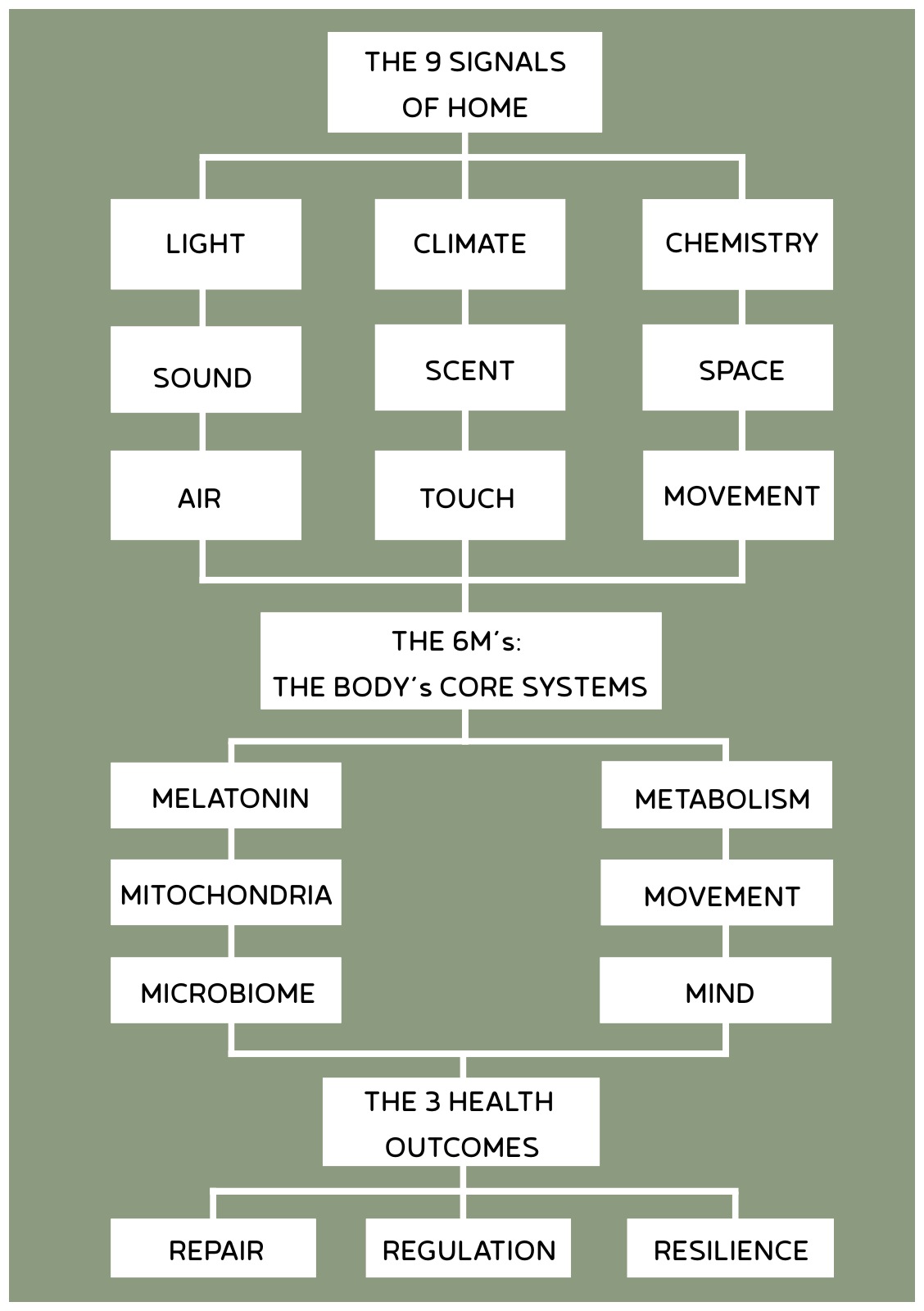
For readers interested in the detailed academic articulation, the full position paper appears below.
Nervous System Design:
A System Level Framework Linking the Built Environment to Autonomic Regulation and Biological Resilience.
Author: Nikki Hunt
Abstract
Modern building science has prioritised structural safety, energy efficiency, and aesthetic innovation. However, converging research across evolutionary biology, circadian science, autonomic neuroscience, environmental health, and systems physiology suggests that the built environment functions as a continuous regulatory input rather than a neutral backdrop.
This paper proposes Nervous System Design (NSD) as an interdisciplinary framework for examining how environmental conditions within indoor spaces shape autonomic regulation and biological resilience. NSD conceptualises the built environment as a set of distinct signal pathways — light, sound, air, climate, scent, touch, chemistry, spatial cues, and movement — through which environmental information is continuously detected and processed by the nervous system.
These signals are not merely perceived. They are translated into physiological response.
NSD proposes that environmental signals influence regulatory balance through a structured pathway: environmental inputs are processed by the nervous system and expressed through downstream biological systems, including melatonin signalling, mitochondrial function, microbiome stability, metabolic regulation, movement variability, and cognitive–emotional control.
The Great Sensory Unravelling (GSU) is introduced as a conceptual model describing how contemporary interiors may compress or distort these signals across four domains: sensory understimulation, sensory overstimulation, sensory incongruence, and material–chemical load. In addition to introducing novel exposures, modern environments may also reduce or remove biologically expected inputs, narrowing the range of signals available for physiological calibration.
NSD does not assert singular causation between architectural design and disease. Rather, it offers a structured lens through which environmental alignment may be examined as a contributor to cumulative allostatic load. The framework is grounded in measurable physiological markers and invites empirical testing across architectural and environmental contexts.
1. The Blind Spot in Modern Architecture
Architectural standards have historically prioritised structural integrity, thermal performance, ventilation, and aesthetic coherence. These are essential. But they do not fully account for how the human body experiences the environments we create.
The built environment is not neutral. It is continuously interpreted by the nervous system through a set of environmental signals — including light, sound, air, climate, scent, touch, chemistry, spatial cues, and movement — which shape how the body regulates itself over time.
Research across circadian biology, autonomic neuroscience, and environmental health demonstrates that these signals influence core physiological processes, including hormonal rhythms, stress regulation, metabolic function, and immune activity. Yet these mechanisms are rarely considered as explicit design parameters.
In practice, this creates a blind spot.
Buildings are designed to meet technical and aesthetic standards, but not necessarily to align with the regulatory expectations of the human nervous system. As a result, environments may meet performance criteria while still placing a continuous, low-level demand on the body’s regulatory systems.
Nervous System Design begins by addressing this gap.
2. Positioning Nervous System Design Within Existing Frameworks
Over the past two decades, biophilic design and neuroaesthetics have expanded the conversation around the relationship between environment and human experience.
Biophilic design emphasises humanity’s evolutionary relationship with nature and promotes the use of natural materials, daylight access, and organic forms within architecture (Kellert & Calabrese, 2015; Wilson, 1984). Neuroaesthetics investigates how perceptual qualities such as proportion, symmetry, colour, and pattern influence neural activation and subjective experience (Zeki, 1999; Chatterjee, 2014).
Both frameworks have contributed substantially to understanding how built spaces affect perception and wellbeing.
However, these approaches primarily address how environments are experienced and interpreted at a perceptual level. They do not consistently integrate the physiological mechanisms through which environmental conditions influence circadian timing, autonomic regulation, metabolic function, immune activity, and multisensory coherence.
Nervous System Design builds upon these foundations by shifting the emphasis from perceptual experience to physiological regulation. It proposes that built environments operate as continuous sources of biological input, communicated through distinct environmental signals — including light, sound, air, climate, scent, touch, chemistry, space, and movement — which are detected, processed, and translated into regulatory response.
In this framework, environmental conditions are evaluated not only for their aesthetic or experiential qualities, but for their influence on core regulatory systems, including:
• Circadian phase alignment
• Autonomic balance
• Inflammatory and immune activity
• Metabolic timing and efficiency
• Multisensory coherence
In this sense, NSD does not replace biophilic design or neuroaesthetics. It extends them by situating perceptual experience within a broader physiological context, linking environmental conditions to measurable biological outcomes.
3. The Great Sensory Unravelling: A Conceptual Model
The Great Sensory Unravelling (GSU) is proposed as a conceptual model describing how contemporary indoor environments may diverge from the sensory conditions under which human regulatory systems evolved.
Rather than focusing on isolated environmental hazards, GSU examines cumulative alterations in environmental input across the primary signal pathways of light, sound, air, climate, scent, touch, chemistry, space, and movement. These signals represent the channels through which the environment is continuously detected and interpreted by the nervous system.
In modern interiors, these signals are often compressed, distorted, or removed. Environments may introduce novel exposures, while simultaneously reducing or eliminating biologically expected inputs. GSU proposes that this combination — excess, deficit, and inconsistency — may influence autonomic regulation and adaptive capacity over time.
The model identifies four categories of environmental compression or distortion.
3.1 Sensory Understimulation
Environmental enrichment research demonstrates that sensory complexity influences neural plasticity. Animal studies have shown that enriched environments increase synaptic density and cortical thickness relative to minimal conditions (Rosenzweig & Bennett, 1966; Diamond et al., 1964). Subsequent research suggests that sensory variability is associated with cognitive flexibility and resilience (Nithianantharajah & Hannan, 2006).
While direct extrapolation from animal models to human residential environments requires caution, these findings support the principle that variability in sensory input contributes to neural calibration.
Modern interiors often prioritise uniformity, climate control, and visual minimalism. Relative to ancestral outdoor conditions, this may reduce variation across multiple signal pathways, including light gradients, airflow, thermal fluctuation, tactile diversity, acoustic depth, and microbial exposure.
GSU proposes that prolonged reduction in sensory variability may narrow adaptive range, though longitudinal human evidence in architectural contexts remains limited.
3.2 Sensory Overstimulation
In contrast to understimulation, chronic sensory load has been associated with sustained physiological activation. Environmental noise exposure has been linked to elevated cortisol levels, impaired attentional performance, and increased cardiovascular risk (Evans & Johnson, 2000; Münzel et al., 2018).
Similarly, artificial light exposure at night suppresses melatonin and disrupts circadian phase alignment (Gooley et al., 2011).
GSU conceptualises overstimulation as persistent environmental input that maintains sympathetic activation beyond adaptive necessity. Over time, sustained activation may contribute to reduced regulatory flexibility.
3.3 Sensory Incongruence
Predictive processing theory proposes that the brain continuously generates models to minimise prediction error between expected and incoming sensory input (Friston, 2010; Clark, 2013; Seth, 2015).
When signals conflict across pathways — for example, visually natural materials paired with synthetic tactile properties, or warm visual lighting combined with acoustically harsh environments — prediction error may increase neural activity and metabolic demand.
GSU proposes that sustained sensory incongruence may contribute to low-grade autonomic arousal through persistent prediction error signalling. Empirical validation within architectural environments remains limited.
3.4 Material–Chemical Load
Indoor environments contain volatile organic compounds (VOCs), particulate matter, and synthetic materials that differ in exposure profile from ancestral outdoor conditions. Research links particulate exposure and microplastics to oxidative stress and inflammatory responses (Allen et al., 2016; Jenner et al., 2022; Amato-Lourenço et al., 2021).
Sealed, energy-efficient buildings may alter ventilation dynamics and exposure duration.
In parallel, modern environments may reduce exposure to diverse environmental microbes through filtration, antimicrobial materials, and reduced contact with natural systems.
GSU proposes that chronic low-level chemical exposure, combined with reduced biological exposure, may influence inflammatory tone and regulatory stability, contributing to cumulative physiological load. GSU therefore reframes modern environments not as isolated stressors, but as altered signal landscapes.
4. Regulatory Domains Influenced by Environmental Signals
Nervous System Design proposes that environmental signals influence physiological regulation through autonomic and circadian pathways. These signals are continuously detected and processed by the nervous system, shaping how the body allocates energy between vigilance, adaptation, and repair.
The following domains are conceptualised as interconnected regulatory systems responsive to environmental timing, sensory coherence, and exposure patterns. Together, they form a set of core biological processes through which environmental conditions may influence resilience over time.
4.1 Metabolic Regulation
Circadian misalignment has been shown to impair glucose tolerance, alter insulin sensitivity, and increase cardiometabolic risk (Scheer et al., 2009), with broader evidence linking disrupted sleep patterns to similar metabolic effects (Knutson et al., 2007). The hypothalamus integrates light-mediated circadian signals with metabolic regulation, linking environmental timing — particularly light exposure — to metabolic efficiency.
4.2 Mitochondrial Energetics
Autonomic activation and circadian disruption have been linked to oxidative stress and altered mitochondrial function (Picard et al., 2018). While direct evidence connecting architectural variables to mitochondrial efficiency remains limited, stress-mediated pathways provide a plausible regulatory link between environmental conditions and cellular energy production.
4.3 Microbiome Stability
The gut microbiome exhibits circadian oscillations influenced by host timing signals (Thaiss et al., 2014). Stress and circadian disruption are associated with altered microbial composition and intestinal permeability (Konturek et al., 2011).
Environmental signals — particularly those related to air exchange, material chemistry, and surface interaction — influence patterns of microbial exposure. Natural materials and outdoor air exchange introduce greater microbial diversity, whereas sealed, climate-controlled interiors and antimicrobial practices may reduce microbial variability (Kembel et al., 2012; Dunn et al., 2013).
Environmental conditions may therefore shape microbiome stability through both circadian and ecological pathways.
4.4 Melatonin Signalling
Light exposure at night suppresses melatonin production and alters sleep architecture (Gooley et al., 2011). Melatonin contributes to immune modulation and mitochondrial protection.
In addition to light, thermal variation functions as a circadian cue. Stable, climate-controlled environments may reduce natural temperature fluctuations that help anchor circadian phase (Kräuchi et al., 2007).
Lighting and thermal conditions therefore represent key environmental variables influencing melatonin regulation.
4.5 Movement and Vestibular Variability
Architectural environments that reduce variability in movement and sensory input may influence neuromuscular adaptability and autonomic balance. Reduced postural variability and limited vestibular stimulation in static indoor environments represent plausible mechanisms, though direct longitudinal architectural evidence remains limited.
4.6 Cognitive–Emotional Regulation
Reduced heart rate variability is associated with diminished cognitive flexibility and emotional regulation (Thayer et al., 2012). Environmental stressors, including chronic noise and light disruption, have been linked to mood disturbance and attentional impairment (Basner et al., 2014).
Predictive processing frameworks suggest that sustained sensory incongruence may increase cognitive load through persistent prediction error signalling (Friston, 2010).
Emerging research indicates that exposure to natural materials, including visible wood surfaces, may be associated with increased parasympathetic activation as measured by heart rate variability (Fell, 2010; Ikei et al., 2017). While mechanisms remain under investigation, these findings support the hypothesis that material properties may modulate autonomic tone.
Together, these domains describe how environmental signals are expressed within the body.
5. Architecture as Continuous Biological Exposure
Humans in industrialised societies spend approximately 90% of their time indoors (Klepeis et al., 2001). As a result, indoor environments constitute a dominant exposure context across the lifespan.
Unlike discrete environmental exposures, such as acute pollutants or episodic stressors, architectural conditions operate continuously. Lighting patterns, acoustic environments, air composition, thermal conditions, material chemistry, and spatial configuration provide persistent streams of environmental signals that are detected and processed by the nervous system.
These signals are not experienced intermittently. They are ongoing inputs that shape how the body regulates in real time.
Chronic exposure to low-level environmental conditions has been associated with cumulative physiological burden, often described as allostatic load (McEwen & Stellar, 1993; McEwen, 1998). While architecture is rarely conceptualised within this framework, NSD proposes that patterns of environmental misalignment — including disruption of circadian timing, sensory incoherence, and persistent low-level chemical exposure — may contribute to cumulative regulatory strain over time.
Importantly, environmental design differs from behavioural intervention. Behavioural strategies require conscious effort and consistency. Architectural conditions, once established, operate passively and continuously, shaping regulatory input without requiring ongoing attention.
This positions the built environment as a potentially scalable regulatory variable.
NSD does not assert that architecture singularly determines health outcomes. Rather, it proposes that environmental signals interact with behavioural and genetic factors within broader health trajectories.
The built environment is therefore not simply where life takes place.
It is part of the system that shapes how the body functions.
Conclusion
Nervous System Design reframes the built environment as a regulatory interface rather than a neutral container.
Across disciplines — from circadian biology and autonomic neuroscience to environmental health and stress physiology — evidence increasingly demonstrates that environmental signals shape physiological regulation. Light timing, acoustic stability, air quality, thermal variation, material chemistry, spatial cues, and movement are not merely experiential variables; they are inputs into systems that govern metabolic efficiency, inflammatory tone, cognitive flexibility, and repair.
The Great Sensory Unravelling offers a conceptual model for understanding how modern interiors may compress, distort, or remove these signals. The six regulatory domains outlined in this framework describe biological systems that appear particularly sensitive to environmental conditions. Together, they suggest that architectural environments participate in shaping baseline regulatory balance.
This does not imply that architecture singularly determines health outcomes. It does suggest that environmental alignment — or misalignment — may contribute to cumulative physiological load over time.
If this is correct, the built environment represents a largely overlooked context for preventative health.
When environmental signals are aligned with the nervous system’s regulatory expectations, design can function as a form of preventative support — not by treating disease, but by shaping the conditions under which regulatory systems operate efficiently.
The nervous system does not experience architecture as aesthetic alone.
It experiences it as physiology.